Most data platforms do not fail because AES is weak.
Most fail because too many systems can decrypt too much data with too little control.
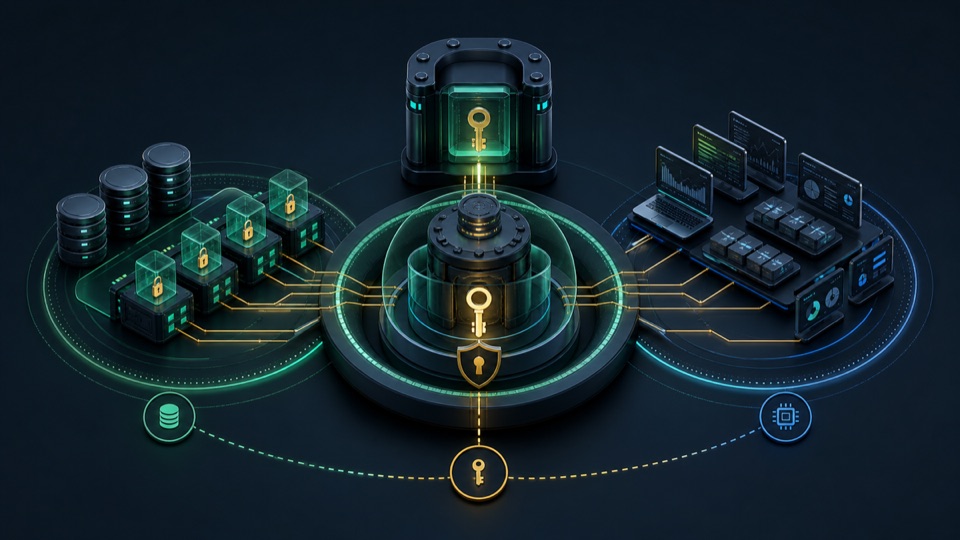
Envelope encryption is the practical way to keep encryption usable at platform scale. It is not a promise that decryption is impossible. It is a framework to reduce blast radius.
The key stack: DEK, CEK, KEK, and KMS
In practical terms:
- DEK/CEK protects actual data at rest.
- KEK (or CMK, depending on provider language) protects DEKs in a central key service.
- KMS keeps keys in a central policy boundary.
- Wrapping means the DEK is encrypted by a key from the KMS and stored alongside data metadata.
This is good because you do not need to re-encrypt all stored data every time you rotate a top-level key.
Why symmetric encryption plus central KMS
Symmetric encryption at storage/service layers stays fast and manageable. The KMS adds centralized control: audit, lifecycle, and separation between storage operators and key operators. The result is better than embedding keys per service, as long as governance is explicit.
Rotation: rewrap vs full re-encryption
Rotation confusion causes many false incidents.
- If you rotate KEK with wrapped DEKs, you often only need rewrap operations.
- If crypto policy requires algorithmic upgrades, some cases still require data re-encryption.
Treat this as an operating decision, not just a compliance checkbox.
Where plaintext still appears
Envelope encryption protects stored bytes. Plaintext still appears in memory and in authorized compute paths. Anyone with strong workload access can still process plaintext if access controls are weak.
So security still depends on workload isolation, short-lived credentials, and strict authorization.
KMS audit logs are not full data access proof
Key usage logs are important. They are also incomplete.
An API call can prove a key was requested. It does not prove which app instance requested the decrypted payload, what transformation happened afterward, or whether least-privilege policy was enforced end-to-end.
DEK granularity and boundaries
Fine-grained DEKs reduce impact when one dataset segment is rekeyed or revoked. Coarse DEKs increase operational convenience and increase blast radius. You need to choose based on risk profile, not simplicity alone.
Storage-layer vs application-layer
Storage-layer encryption covers object confidentiality at rest and key rotation mechanics. Application-layer encryption can constrain exposure in memory and application-specific flows, but it increases engineering complexity and key-carrying paths.
Neither layer alone is enough.
What envelope encryption does not solve
It does not replace authorization.
It does not replace tokenization, masking, row-level permissions, or network segmentation.
It does not prevent misuse by an authorized user or application that legitimately has access. Envelope encryption limits what happens after a boundary breach.
Related tools
- Measure governance posture with Governance Readiness Scorecard.
- Test operating decisions with Architecture Decision Roulette.
- Run a quick baseline check in Data Platform Maturity Checker.
References
- AWS KMS cryptographic details
- Google Cloud KMS envelope encryption
- Azure Storage client-side encryption
- NIST KEK glossary
- NIST SP 800-38F
Disclosure
This article was co-written with an AI agent and reviewed by Rujikorn Ngoensaard.