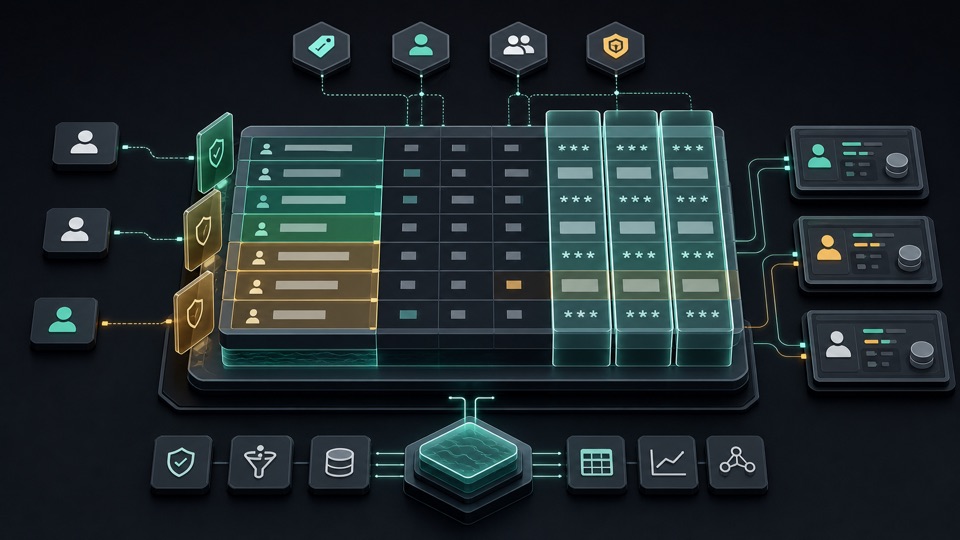
ABAC is a strong control pattern because it can move row and column rules away from one-table-at-a-time patching. That does not make it automatic governance.
In Unity Catalog, attribute-based access control depends on governed tags, policy scope, row filter logic, column mask logic, group membership, and runtime behavior. Each of those needs an owner.
Decision rule
ABAC centralizes policy expression. It does not remove the need for production ownership.
The policy is not the ownership model
The most common mistake is treating ABAC as a security feature that someone can turn on after access has already sprawled.
ABAC row filters and column masks restrict visibility at query time. They do not replace object-level grants. A user still needs permission to access the object before a policy can constrain what that user sees.
That distinction matters. If grants are too broad, ABAC becomes the last line of defense. If tags are wrong, policies are missing, or exemptions are careless, the control can look consistent while the platform is carrying silent risk.
What ABAC actually centralizes
ABAC lets platform teams define policies that apply based on governed tags and scope. A policy can apply at catalog, schema, table, or column level depending on how it is written and where the governed tags live.
That is powerful because higher-level ABAC policies are harder for individual table owners to remove or bypass than table-level filters and masks. It helps the platform express cross-domain controls consistently.
But centralization changes the risk shape:
- a tag taxonomy becomes a security boundary,
- tag assignment becomes an access-control operation,
- policy UDFs become production code,
- exempt principals become formal exceptions,
- and readback becomes part of the release process.
Watch out
Governed tags are not harmless metadata. Changing tags can change which security policy applies.
Column classification needs special care. A tag inherited at catalog, schema, or table level does not automatically classify every column. Sensitive columns need deliberate column-level treatment where the policy depends on column tags.
The ownership map
Before production rollout, name owners for each part of the control:
| Surface | Owner question |
|---|---|
| Governed tag taxonomy | Who can create, rename, or retire security tags? |
| Tag assignment | Who approves tags on catalogs, schemas, tables, and columns? |
| Policy logic | Who owns the SQL UDF and policy condition? |
| Group membership | Who controls the principal lists referenced by policy logic? |
| Exceptions | Who approves an EXCEPT clause and how often is it reviewed? |
| Compatibility | Who checks runtimes, workloads, sharing, and cross-engine behavior? |
| Performance | Who tests representative queries before rollout? |
| Audit readback | Who proves the effective policy after change? |
If any row says "platform team, probably," the model is not ready yet. Production ABAC needs explicit responsibility, not shared hope.
Where production risk enters
ABAC risk usually appears around the edges, not in the basic syntax.
Missing tags can stop a policy from applying. Missing or deleted tags and UDFs referenced by a policy can also fail queries, so policy dependencies need the same release discipline as production code. Broad exemptions can turn into permanent bypasses. Older runtimes or unsupported surfaces can make a design look portable when it is not.
Materialized views, streaming tables, Delta Sharing, and cross-engine access deserve separate checks. They do not always behave like a simple interactive query against a managed table. The run identity, refresh behavior, owner permissions, and runtime support can change what "the same policy" means operationally.
Design check
Do not approve a policy until representative workloads have been tested, not only ad hoc SELECT statements.
UDFs are production code
Row filters and column masks often rely on SQL UDFs. That makes the UDF part of the platform's security and performance surface.
Keep policy UDFs simple:
- deterministic where possible,
- small enough to review,
- typed clearly,
- tested with representative principals,
- tested with representative query shapes,
- and owned like production code.
Avoid heavy Python UDFs, large lookup joins, complex regular expressions over wide text payloads, and anything that turns a security policy into a hidden performance problem.
The policy should be boring. If the logic needs a diagram to explain, it may belong in a governed table design or access model first, not directly inside the mask.
EXCEPT is an operational contract
The EXCEPT clause is useful. It can keep platform owners, auditors, emergency operators, or trusted service identities from being blocked by a rule that is meant for normal consumers.
It is also easy to misuse.
Treat every exemption as a named exception:
- who is exempt,
- why they are exempt,
- who approved it,
- when it expires or gets reviewed,
- and what audit evidence confirms the exception is still needed.
If the exception list becomes the easiest place to fix access complaints, the ABAC program is drifting back toward manual policy sprawl.
Verification is part of the rollout
Production policy work needs readback. Creation syntax is not enough.
Use the available policy inspection commands and evidence surfaces:
- show effective policies for the secured object,
- list and describe policies after deployment,
- query as representative principals where possible,
- inspect audit logs for policy and tag changes,
- check workload behavior across the intended runtime surfaces,
- and review exceptions on a schedule.
The goal is not only to prove that a policy exists. The goal is to prove which policy applies, why it applies, who can change it, and what a consumer will actually see.
A practical rule
ABAC is ready for production when the team can answer six questions:
- Who owns the tag?
- Who owns the policy?
- Who can change either one?
- Who is exempt?
- What workload might break?
- How do we know the policy is effective today?
If those answers are unclear, row filters and column masks may still be useful, but they are not yet a production operating model.
Related tools
- Use the Access Model Simulator before centralizing row and column controls.
- Run the Governance Readiness Scorecard to test whether the broader platform can support policy ownership.
- Check the broader operating model with the Data Platform Maturity Checker.
References
- Databricks: Attribute-based access control in Unity Catalog
- Databricks: Core concepts for ABAC
- Databricks: Create and manage ABAC policies
- Databricks: Best practices for ABAC policies
- Databricks: Performance considerations for ABAC policies
- Databricks: When to use ABAC vs table-level row filters and column masks
- Databricks: ABAC requirements, quotas, and limitations
- Databricks: Policy evaluation and runtime behavior
- Databricks: Row filters and column masks
Disclosure
This article was co-written with an AI agent and reviewed by Rujikorn Ngoensaard.