Summary
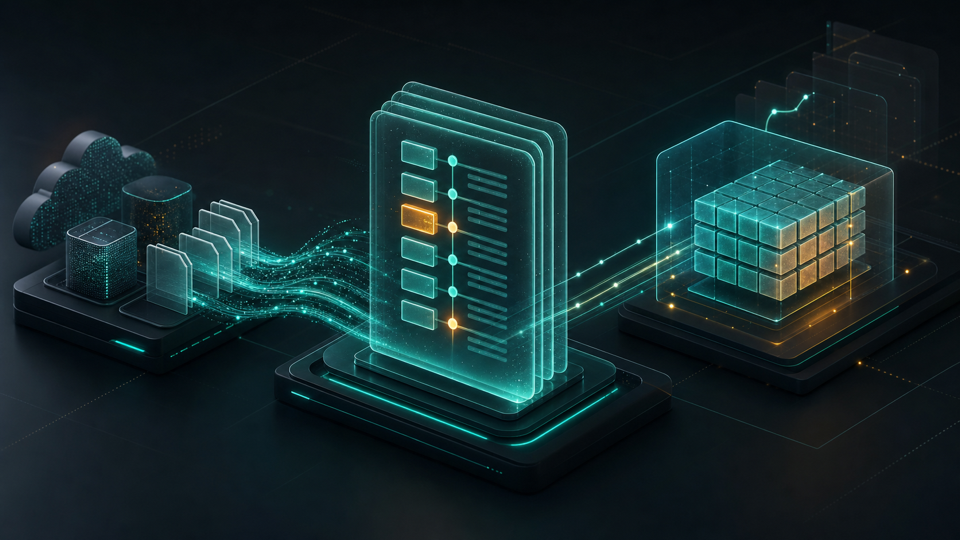
Delta Lake does not make object storage behave like a database by hiding complexity. It adds a transaction log beside the data files, then forces readers and writers to agree on table state through that log.
The useful way to think about Delta Lake is not "data lake plus ACID". That phrase is directionally true, but it hides the part that matters in production: the transaction log becomes the table's source of truth.
A raw data lake usually has files and conventions. A Delta table has files, conventions, and a ledger of commits that tells engines which files belong to the current snapshot, which files were removed, what metadata applies, and which protocol features the table expects readers and writers to understand.
That sounds small until a team starts doing real work: streaming into the table, merging corrections, enforcing schema, replaying a pipeline, debugging a dashboard that changed overnight, or cleaning old files without breaking time travel.
The problem is not storing files
Object storage is good at storing files cheaply. It is not, by itself, a table management system.
If a folder contains Parquet files, a reader can scan those files. But the reader still needs answers to harder questions:
- Which files are part of the table right now?
- Was a write fully committed, or did it fail halfway?
- Did a delete actually remove records, or only add a newer replacement file?
- Which schema should this reader trust?
- Can another job write at the same time without corrupting the table state?
- Can the platform explain what the table looked like yesterday?
Without a transaction layer, teams often answer these questions with naming conventions, orchestration discipline, or a metastore entry that points at a folder. That can work for append-only landing zones. It becomes fragile when the table has updates, deletes, merges, compaction, schema changes, and multiple engines.
Delta Lake's central move is to separate physical files from logical table state.
What is inside the transaction log
A Delta table stores data files in object storage and keeps a _delta_log directory beside them. The log contains ordered commits. Each commit records actions that change the table.
At a practical level, those actions answer four questions.
| Question | Log action concept | Why it matters |
|---|---|---|
| What data files are active? | add and remove file actions | Readers can build a consistent snapshot without guessing from the folder listing. |
| What does the table mean? | metadata actions | Schema, partitioning, and configuration become explicit table state. |
| Which engines can read/write this table? | protocol actions | New features can require compatible readers and writers instead of silently misreading data. |
| What operation produced this version? | commit information | Operations, metrics, and history become inspectable during incidents. |
The data files still matter. Delta Lake is not replacing Parquet. It is adding a table contract above the files.
That contract is what lets a query read "version 42" of a table even if the folder contains files from many historical versions. The reader does not ask object storage, "what files are under this path?" and trust the answer as table truth. It reconstructs the snapshot from the log.
ACID is a behavior, not a slogan
The transaction log is also how Delta Lake delivers the behavior people summarize as ACID.
Atomicity means a write is either visible as a committed table version or not visible. Consistency means a committed version follows the table protocol and metadata rules. Isolation means readers can see a stable snapshot while writers are producing newer versions. Durability means committed data and log records survive as objects in storage.
The part worth remembering is that the log does not make every downstream process correct. It gives the platform a reliable table boundary. Your pipelines still need idempotency, retry behavior, ownership, and monitoring.
A merge that is logically wrong will still be committed correctly. A schema evolution that is technically valid can still break a semantic model. A vacuum operation that follows the rules can still remove files someone expected to time travel to if retention was misunderstood.
Delta Lake gives teams a safer table substrate. It does not remove the need for a table operating model.
Why schema enforcement changes the failure mode
In a plain file lake, schema drift often appears late. A producer writes a file with a changed type or renamed column. A downstream reader fails later, or worse, reads something in a surprising way.
With Delta Lake, schema is part of table metadata. Writers are checked against the table schema. That moves many failures earlier, closer to the write path.
That is usually good. It turns a silent data contract break into an explicit write failure.
But enforcement is not the same as design. Teams still need to decide:
- Which columns are stable product contract fields?
- Which fields are experimental or producer-owned?
- Who approves type changes?
- Which consumers must be notified before schema evolution?
- Which tables allow automatic merge schema, and which should reject it?
The transaction log can record the schema. It cannot decide whether a schema change is a good platform decision.
Time travel is just snapshot discipline
Time travel is one of the most visible Delta Lake features, but it is often described too magically.
A Delta table can read an earlier version because the log records historical table states and the old files remain available. When you query a previous version, the engine reconstructs the file set for that version.
This is useful for debugging. If a dashboard changed at 10:00, you can compare table versions before and after that point. If a pipeline correction overwrote business logic, you can inspect the prior state. If a consumer asks when a value changed, table history gives you a place to start.
The operational catch is retention. Old log entries and old data files are not free forever. Cleanup operations such as vacuuming exist because storage and metadata need maintenance.
So the real decision is not "do we have time travel?" The real decision is:
| Need | Design choice |
|---|---|
| Short debugging window | Keep default-ish retention and rely on observability. |
| Regulatory or audit reconstruction | Do not treat table time travel as the only archive. Design retention, backups, and audit stores deliberately. |
| High-churn merge-heavy tables | Monitor file pressure, compaction, and vacuum timing as part of the table SLO. |
| Multi-team consumption | Document retention expectations in the data product contract. |
Time travel is powerful because the table has versions. It is risky when teams assume those versions are a permanent archive.
Deletes and merges are file rewrites with table truth
Object storage does not update a row in place. Delta Lake handles updates, deletes, and merges by writing new files and recording which old files are no longer active for the table snapshot.
That distinction matters.
A delete is not simply "remove this object now". A merge is not simply "mutate these rows inside one file". The table state changes through log actions. Old files may physically remain until cleanup. Readers ignore removed files because the current snapshot says they are removed.
This is why maintenance is not optional. Merge-heavy tables can produce many small files and many remove actions. Readers can still be correct, but performance and metadata pressure can degrade if no one owns compaction and cleanup.
The transaction log buys correctness. It does not buy infinite operational patience.
Where teams still get hurt
Delta Lake helps most when teams know which layer it is responsible for.
It does not fix unclear ownership. If nobody owns the table contract, Delta will faithfully store confusing commits.
It does not replace semantic modeling. A valid table schema can still produce bad metrics if the grain is wrong.
It does not remove cost management. More reliable writes can make it easier to create more tables, more versions, and more maintenance work.
It does not make retention decisions safe by default. Time travel, streaming checkpoints, downstream replay, and vacuum policies must be aligned.
It does not remove the need for compatibility thinking. Protocol features, writer versions, and reader engines matter when multiple tools touch the same table.
A practical operating checklist
Before a team promotes a Delta table as a trusted product table, I want these questions answered:
- Owner: Who owns table schema, retention, layout, and recovery decisions?
- Consumers: Which dashboards, jobs, models, or products depend on it?
- Change policy: Which schema changes are allowed without review?
- Write pattern: Append, overwrite, merge, streaming, or mixed?
- Maintenance: Who owns compaction, clustering/layout, and vacuum timing?
- Replay: Can the pipeline safely reprocess without duplicate business facts?
- History: How far back must the team debug, compare, or audit?
- Compatibility: Which engines are allowed to read and write the table?
- Monitoring: What indicates metadata pressure, failed commits, or layout drift?
This is where Delta Lake becomes a platform tool rather than a storage feature.
The useful mental model
Think of a Delta table as three layers:
- Files: Parquet data in object storage.
- Log: Ordered table commits in
_delta_log. - Operating model: Ownership, retention, layout, schema, recovery, and consumer expectations.
Most introductions stop at the first two layers. Production teams live or fail in the third.
Delta Lake is valuable because the transaction log gives the platform a durable way to reason about table state. It makes reliable snapshots, schema enforcement, time travel, and merges possible on top of object storage.
But the log is not magic. It is a contract. And like every useful contract, it only works when teams know who owns it, when it can change, and what happens when it breaks.
References
- Delta Lake transaction log protocol
- Delta Lake concurrency control
- Delta Lake schema enforcement and evolution
- Delta Lake time travel
- Delta Lake vacuum and table utility commands
Disclosure
This article was co-written with an AI agent and reviewed by Rujikorn Ngoensaard for technical accuracy, scope, and editorial fit.